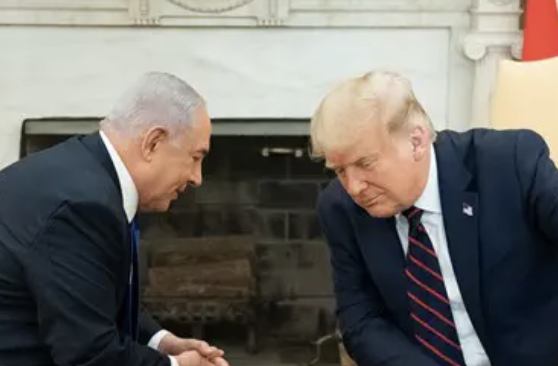
President Trump said Tuesday that he and Israeli Prime Minister Benjamin Netanyahu agreed months ago to end the roughly $4 billion a year the United States gives Israel, and that the payments will stop at the end of this year.
Trump made the announcement in a phone interview with “Fox & Friends” on Election Day morning. “Bibi Netanyahu and I have made a deal that we give Israel $4 billion a year, and we made a deal months ago that we’re stopping,” he said. “We’ve already agreed that by the end of this year we won’t be paying Israel. Now we’ll help Israel if they need it.”
BREAKING: President Trump says the U.S. will end roughly $4 billion in annual aid to Israel by the end of the year, revealing that Prime Minister Benjamin Netanyahu agreed to the decision. “Because they don’t need it,” Trump said during an exclusive interview on @foxandfriends, describing Israel as a thriving country that no longer requires American financial assistance. Trump also said Netanyahu raised the idea of ending the aid himself. He emphasized that Israel remains one of America’s most reliable allies as the two countries prepare for a major shift in their financial relationship. Download the FOX News app for the latest details: https://t.co/ISpW9Fc0R3
— Fox News (@FoxNews) November 3, 2026
Whose idea it was
Trump said the proposal came from Netanyahu. “Can I be honest with you? He brought it up,” Trump said, quoting the prime minister as telling him, “I think it would be appropriate if we do not receive aid.”
“Israel is a very thriving country,” Trump said. “They don’t need it. If they did need it, I would say keep it going.”
He said Israel will still be able to buy American weapons. “Oh yeah, they can buy whatever they want,” he said.
Trump also said the money had become a talking point for the left. He named Abdul El-Sayed, the Michigan Democrat who won his Senate race Tuesday night after calling for restrictions on military aid to Israel. “Why should we suffer the slings from lunatics like an El-Sayed when they don’t need it?” Trump said. “It’s a bad talking point.”
What the agreement covers
The aid flows from a 10-year memorandum of understanding signed under President Obama in 2016. It provides $3.3 billion a year in military financing and $500 million a year for joint missile defense, a total of $38 billion through September 2028. Congress must still approve the money each year.
Netanyahu has said for months that he expects American aid to wind down. In an October interview with Israeli television, he told Israelis to “get used to the fact that it won’t happen because America has changed,” referring to the billions he had secured in past agreements.
Netanyahu’s office did not comment Tuesday, and the Jerusalem Post reported that Israeli defense officials were surprised by the timing. Trump did not explain how the 2028 agreement would be ended early.
Israeli opposition leader Gadi Eisenkot said on X that Netanyahu’s conduct “poses a genuine danger.” Rep. Don Bacon, R-Neb., told CNN his concern was that “the Israelis didn’t know about it.” On the left, Rep. Ro Khanna, D-Calif., wrote on X that “zero aid Israel” would be on his party’s agenda.
The bottom line
Ending the annual check is good for both countries. Israel has a high-tech economy, one of the most capable militaries in the world and a prime minister who says his country has outgrown the aid. A nation that pays for its own defense makes its own decisions without a foreign Congress debating every shipment. It also frees Israel from critics in Washington who use the aid as leverage.
For Americans, $3.8 billion a year stays home, and the arms industry keeps the sales, since Israel will still buy American. The President also took away the argument that Israel lives on the U.S. taxpayer, which candidates like El-Sayed have used to stir up hostility toward the Jewish state.
The details still have to be settled with Jerusalem and with a Congress that Democrats will soon control. The administration should put the agreement in writing quickly and keep the joint missile-defense work going while the rest is wound down.